Energy calibration
X-ray energy calibration using channel-cut crystal
Channel-cut crystal parameters
Length: 36 mm
Width: 3 mm
Lattice spacing (2d): 3.84 Å
Purpose
Calibrate the monochromator energy using the known lattice spacing of the channel-cut crystal.
Procedure
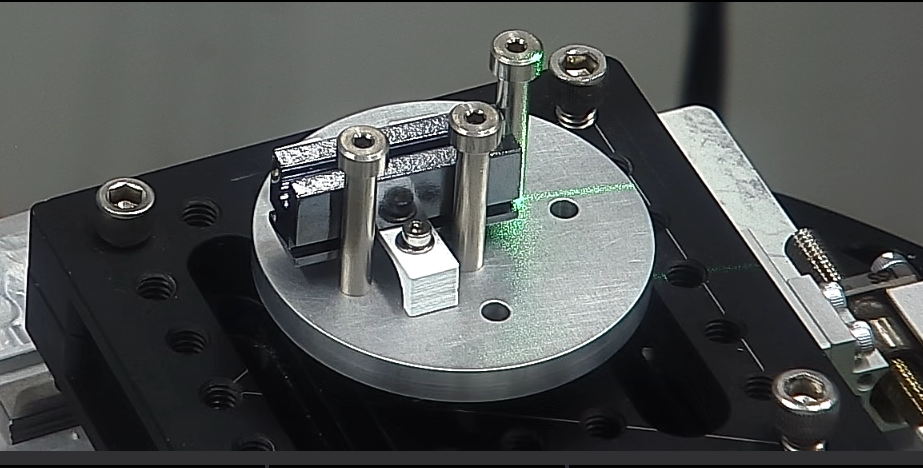
Mount the channel-cut crystal
Secure the channel-cut crystal on the rotation stage in the x-ray beam path.
Align the crystal so the incident beam fully illuminates the 3 mm width and the reflection geometry is symmetric.
Set the rotation angle to zero.
Set initial conditions
Set the monochromator energy to approximately 20 keV.
Compute the expected Bragg angle \(\theta\) using Bragg’s law:
\[E = \frac{12.3984}{2d \sin\theta} \quad [\text{keV}]\]Rearranged:
\[\theta = \arcsin\!\left(\frac{12.3984}{2d\,E}\right)\]where \(2d = 3.84\,\text{Å}\) and \(E = 20\,\text{keV}\).
For a 20 keV x-ray beam, the expected Bragg angle is approximately 9.29°.
Example Python code to compute the expected angle:
import numpy as np

# Parameters
two_d = 3.84         # 2d in Å
E_nom = 20.0         # nominal energy in keV
hc = 12.3984         # hc in keV·Å

# Compute Bragg angle (radians and degrees)
theta_rad = np.arcsin(hc / (two_d * E_nom))
theta_deg = np.degrees(theta_rad)
print(f"Bragg angle at {E_nom} keV: {theta_deg:.6f}°")
Record the reflected x-ray
Rotate the crystal to the calculated Bragg angle and search for the reflected beam.
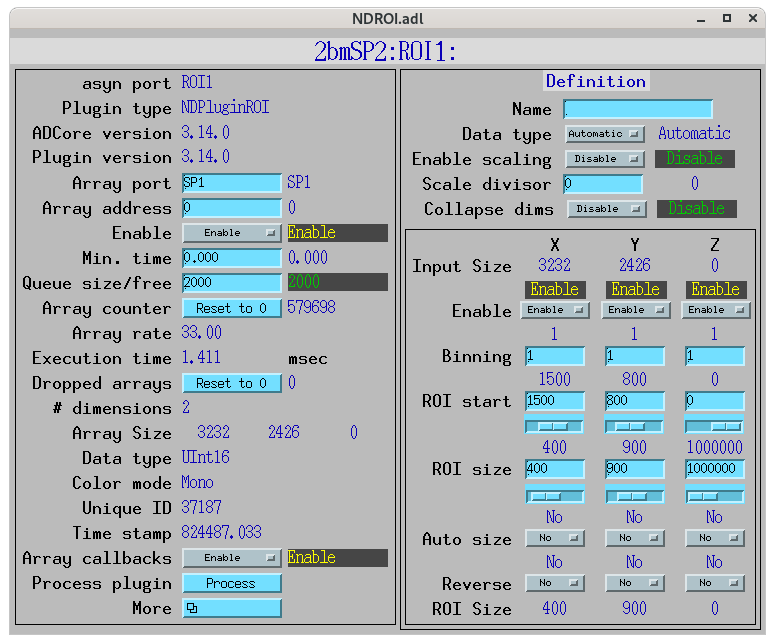
Select an ROI around the reflection using the ROI plugin in areaDetector.
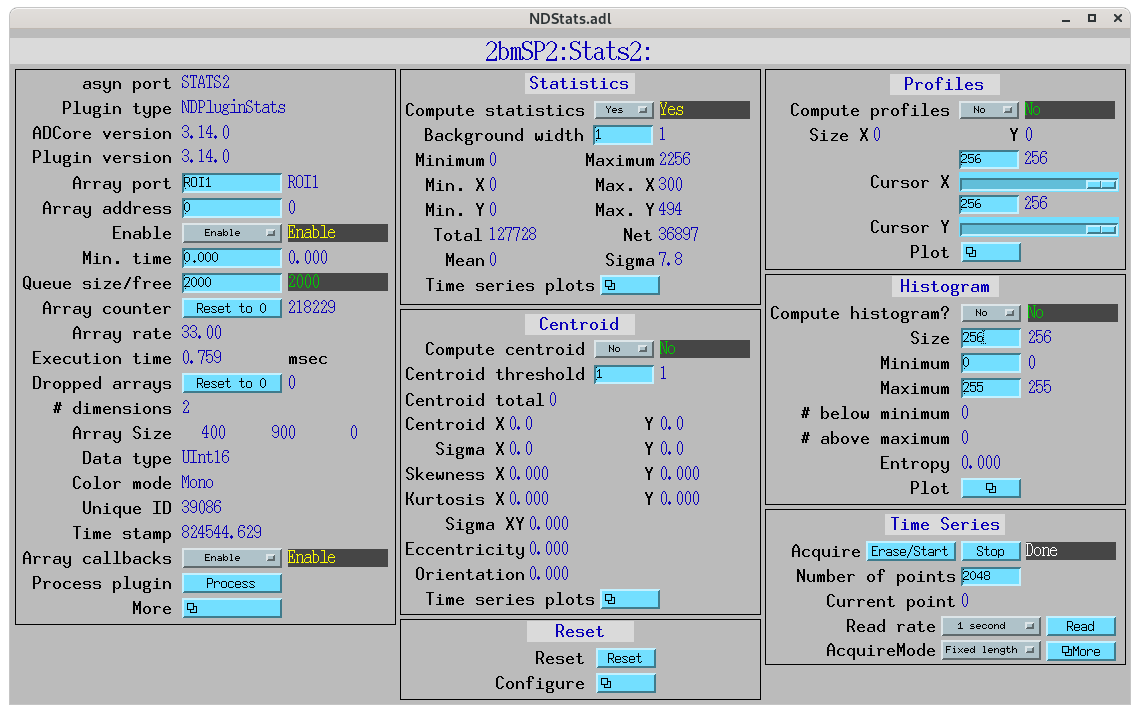
Use the Stat2 plugin to compute the mean intensity in the ROI.
Perform rocking-curve scan
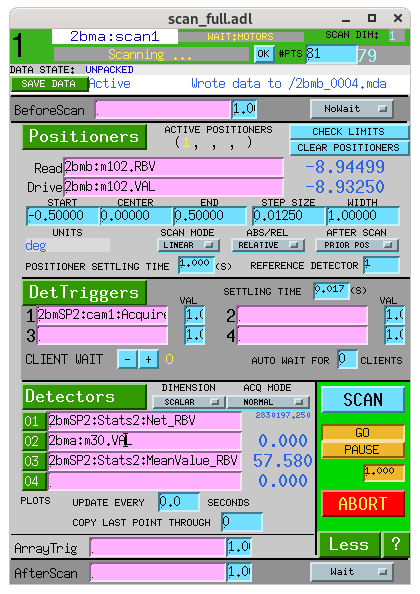
Perform a fine angular scan (rocking curve) around the calculated Bragg angle to record reflected intensity versus angle.
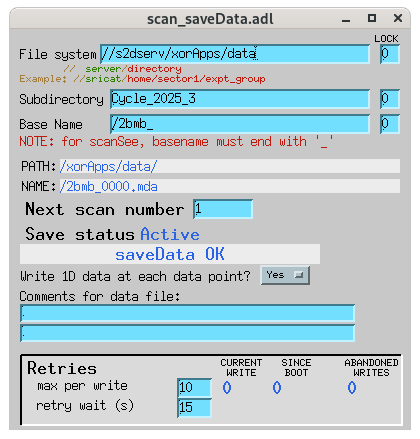
Identify the peak position
Fit the rocking curve to determine the Bragg peak angle \(\theta_B\).
\(\theta_B\) corresponds to the true Bragg condition at the monochromator setting.
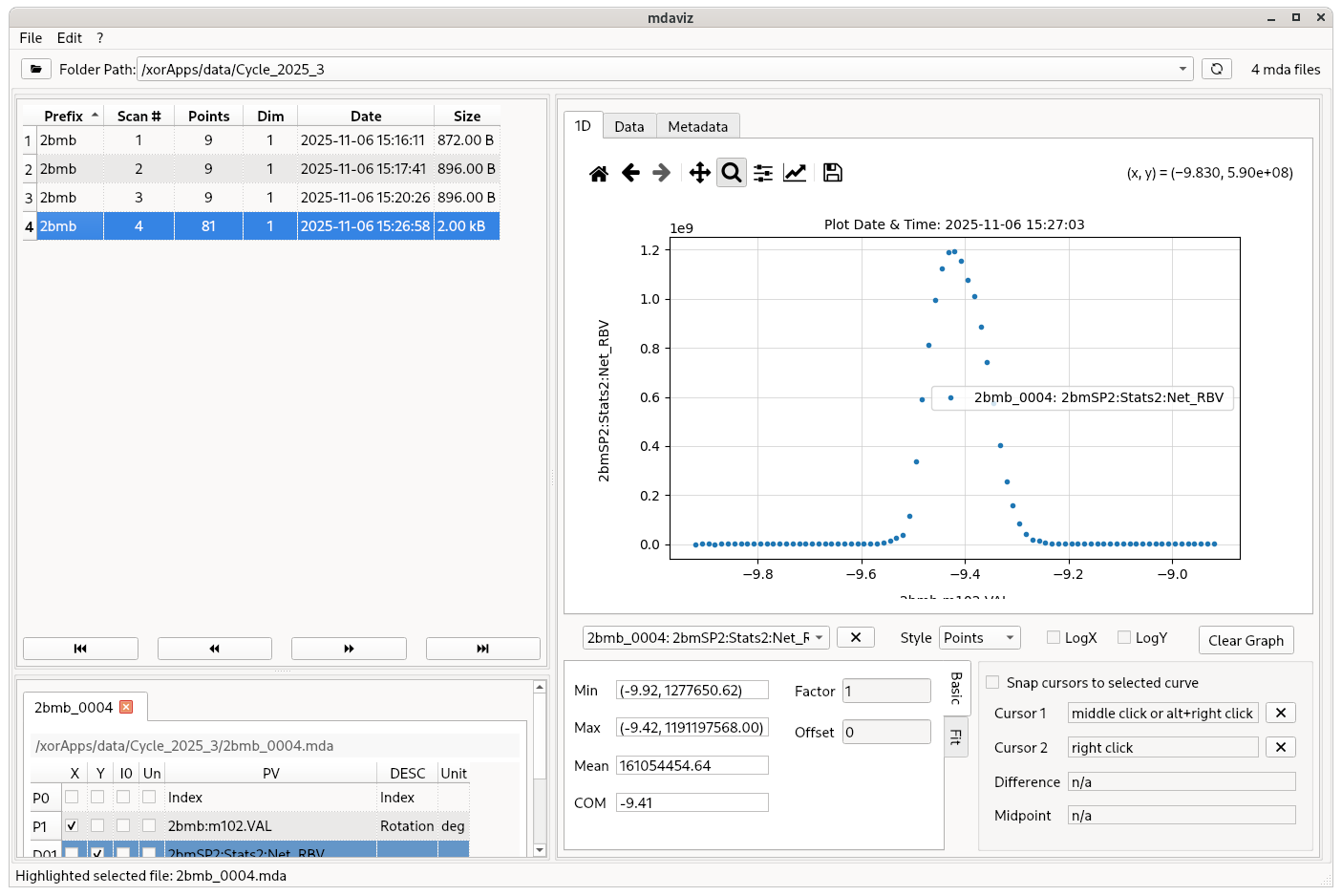
To inspect and fit the data interactively, you can run mdaviz:
(base) 2bmb@arcturus $ cd /APSshare/bin
(base) 2bmb@arcturus $ ./mdaviz
Calculate the true energy
Compute the actual energy using Bragg’s law:
\[E = \frac{12.3984}{2d \sin\theta_B} \quad [\text{keV}]\]
Example Python code to compute the true energy from the measured peak angle:
import numpy as np

# Parameters
two_d = 3.84         # 2d in Å
E_nom = 20.0         # nominal energy in keV
hc = 12.3984         # hc in keV·Å

# Example: replace with measured peak angle in degrees
theta_B_deg = 9.2903
theta_B_rad = np.radians(theta_B_deg)

# Compute measured energy and offset
E_meas = hc / (two_d * np.sin(theta_B_rad))
offset_keV = E_meas - E_nom

print(f"Measured energy: {E_meas:.6f} keV")
print(f"Offset from nominal: {offset_keV:.6f} keV")
Update the monochromator calibration
Compare the measured true energy to the nominal monochromator value (e.g. 20 keV).
Update the per-energy calibration table directly via the
energyCLI; there is no separate “offset” stored anywhere. Two equivalent options, operator’s choice:Update the existing calibrated entry: tweak the optics (typically the DMM upstream / downstream arms and
M2 Y) until the channel-cut rocking curve peaks at exactly the nominal energy, then save the corrected motor positions(base) 2bmb@arcturus $ energy add --energy 20 --mode Mono
This overwrites the existing
20.000 keVrow ofenergy2bm.jsonstore_0with the now-correct motor positions. Recommended when the nominal energy is the operationally-targeted value.Save a new calibrated point at the measured value
(base) 2bmb@arcturus $ energy add --energy 20.05 --mode Mono
This adds a fresh
20.050 keVrow toenergy2bm.jsonwithout modifying20.000. Recommended when the measured value itself is what subsequent operation will target, or when you want to densify the calibration table around a band of interest.
Verify calibration
Repeat the procedure at another energy (e.g. 19 keV or 21 keV) to verify linearity and consistency of the calibration.
Comparison of calculated and measured x-ray energies
The table below lists calculated x-ray energies using a 24 Å W–B4C multilayer period (first-order Bragg reflection) and compares them with measured energies for various incident angles.
Angle (°) |
sin(θ) |
λ (Å) = 2d·sinθ |
Calculated energy (keV) |
Measured energy (keV) |
|---|---|---|---|---|
1.1309999999999922 |
0.0197396 |
0.9475 |
13.09 |
13.374 |
1.0809999999999933 |
0.0188718 |
0.9059 |
13.68 |
13.574 |
0.8220000000000001 |
0.0143412 |
0.6884 |
18.02 |
18.000 |
0.726 |
0.0126695 |
0.6081 |
20.39 |
20.000 |
0.5772499999999998 |
0.0100756 |
0.4836 |
25.63 |
25.000 |
0.5609999999999995 |
0.0097919 |
0.4700 |
26.38 |
25.584 |
Note
Calculated energies are obtained from Bragg’s law:
where \(d = 24\,\text{Å}\) is the multilayer period and \(\theta\) is the incident angle.
Incident angle for given x-ray energies
The table below shows the incident angle \(\theta\) (in degrees) for selected x-ray energies, assuming a 24 Å W–B4C multilayer and first-order Bragg reflection.
Energy (keV) |
Angle ° |
|---|---|
13 |
1.145 |
14 |
1.061 |
15 |
0.990 |
16 |
0.928 |
17 |
0.872 |
18 |
0.823 |
19 |
0.779 |
20 |
0.739 |
21 |
0.703 |
22 |
0.670 |
23 |
0.640 |
24 |
0.612 |
25 |
0.586 |
26 |
0.561 |
27 |
0.538 |
28 |
0.517 |
29 |
0.497 |
30 |
0.478 |
31 |
0.460 |
32 |
0.443 |
33 |
0.426 |
Note
Angles are in degrees (grazing incidence). They are calculated using Bragg’s law:
where \(d = 24\,\text{Å}\) is the multilayer period and \(E\) is the desired x-ray energy in keV.